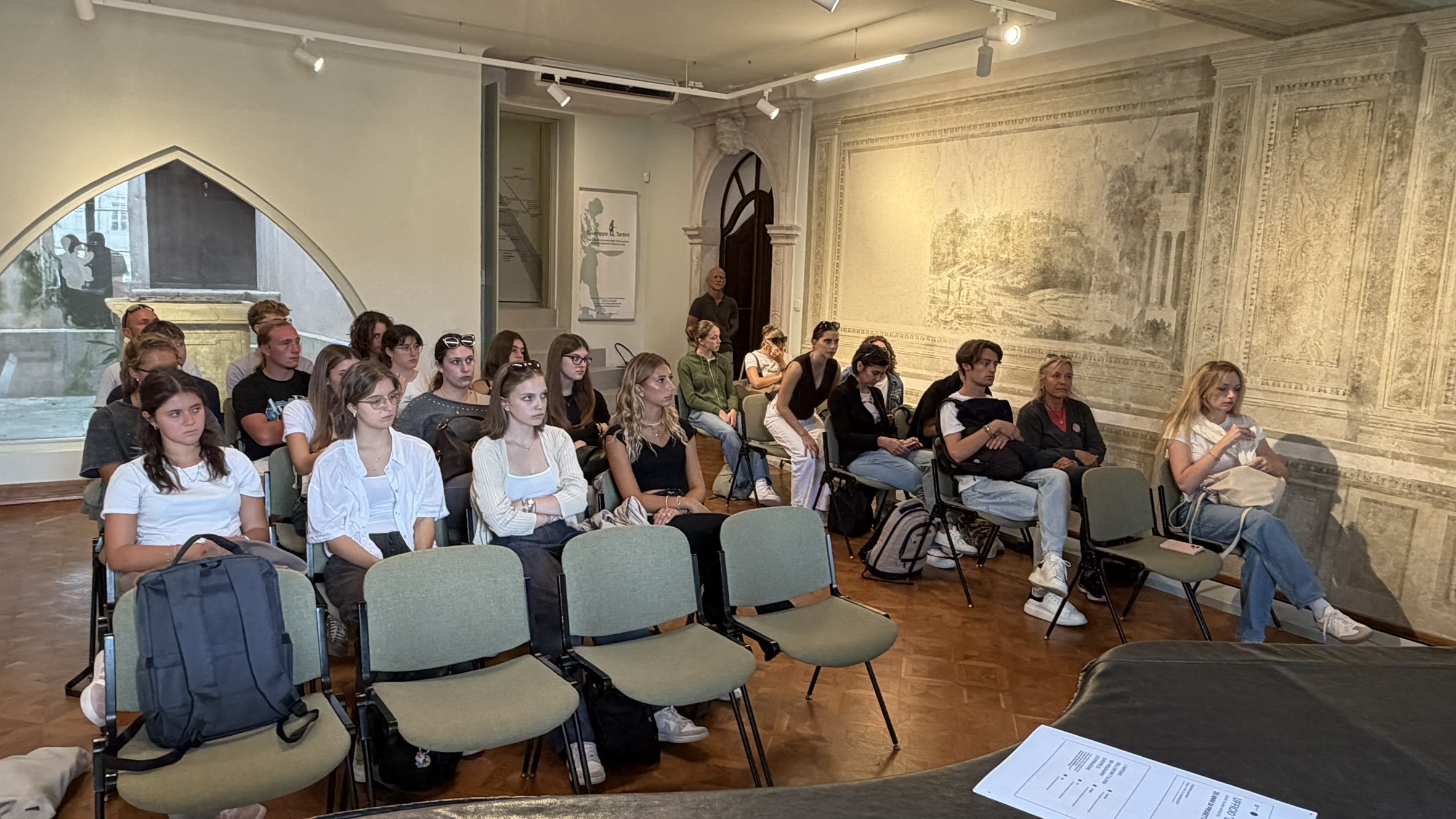
On the afternoon of Monday 21 September 2026, Tartini House, home to the “Giuseppe Tartini” Italian Community in Piran, hosted a meeting on European projects and cross-border cooperation. The event formed part of the second edition of the “Students4cooperation” competition for upper secondary schools in the Programme area, an initiative of the Interreg VI-A Italy–Slovenia Programme 2021–2027.
The teams placed second and third, accompanied by Programme representatives and members of PiNA – the Cultural and Educational Association in Koper, took part in a study visit to learn about activities carried out by projects co-funded under the Italy–Slovenia Programme.
Tartini House in Piran was one of the stops on the visit, attended by two teams of students from schools in Trieste and Gorizia. In all, 25 students, teachers and Interreg Italy–Slovenia Programme staff took part.
The “Europa” Office of the Italian Union in Koper was asked to prepare a presentation on participation in cross-border projects and the TARTINI BIS project, screen the animated film about Tartini and accompany the students on their tour of Tartini House.
The guests were addressed by Maurizio Tremul, coordinator of the Italian Union in Koper and a European project specialist, and fellow European project specialist Marko Gregorič. Andrej Rojec of the “Giuseppe Tartini” Italian Community in Piran welcomed the group and introduced Giuseppe Tartini, the great Italian musician from Piran known as the “Master of Nations”. Kris Dassena conveyed greetings from the Municipality of Piran.
The students then attended a presentation by the Italian Union’s “Europa” Office on more than twenty years of experience in European and cross-border projects, from early initiatives such as “Artists of Two Minorities” and “Poets of Two Minorities” to more recent European projects including PRIMIS, PRIMIS PLUS, TARTINI BIS and RE-ACTIVE.
Maurizio Tremul and Marko Gregorič placed particular emphasis on the value of cross-border cooperation in bringing territories, institutions, communities and people closer together. It encourages intercultural dialogue, mutual understanding and appreciation of the area’s distinctive features, contributing to a spirit of peace and friendship that has strengthened relations across and between Italy, Slovenia and Croatia.
They also drew attention to protecting and promoting the indigenous identities of the region’s national communities, one of the cross-border area’s strengths, and to the role European projects can play in supporting cultural and sustainable tourism that respects local historical, linguistic and cultural heritage.
Through concrete examples, the meeting showed the young participants how a project idea can become activities, initiatives and results with lasting local effects, while strengthening ties between Italy and Slovenia.
The students also had the opportunity to visit Piran, learning more about its historical and cultural heritage and the setting in which many cross-border initiatives have developed.
Students4Cooperation aims to introduce younger generations to European cooperation. It gives students first-hand experience of local projects and encourages them to imagine new forms of collaboration for the future.